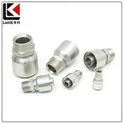
Can a METRIC Adapter be used for satellite communication?
In the realm of modern technology, satellite communication stands as a cornerstone of global connectivity, enabling seamless transmission of data, voice, and video across vast distances. As a supplier of METRIC Adapters, I often encounter inquiries regarding the suitability of these adapters for satellite communication systems. This blog aims to delve into the technical aspects and practical considerations to answer the question: Can a METRIC Adapter be used for satellite communication?
Understanding METRIC Adapters
METRIC Adapters are precision-engineered components designed to facilitate the connection between different types of equipment or systems with metric-based interfaces. These adapters come in various shapes, sizes, and configurations, catering to a wide range of applications in industries such as aerospace, telecommunications, and automotive. They are typically made from high-quality materials such as stainless steel, brass, or aluminum to ensure durability and reliability in demanding environments.


One of the key advantages of METRIC Adapters is their versatility. They can be used to convert between different metric thread sizes, connector types, or signal formats, allowing for seamless integration of diverse equipment. For example, a METRIC Adapter can be used to connect a satellite antenna with a metric interface to a receiver or transmitter with a different metric or non-metric interface. This flexibility makes METRIC Adapters an essential tool for system integrators and engineers working on satellite communication projects.
Satellite Communication Requirements
Satellite communication systems operate in a highly demanding environment, where reliability, performance, and compatibility are of utmost importance. These systems typically consist of a satellite in orbit, ground stations, and user terminals, all of which need to communicate effectively with each other. To ensure seamless operation, satellite communication equipment must meet strict technical standards and specifications.
One of the critical requirements for satellite communication is signal integrity. The adapter used in the system must be able to transmit signals with minimal loss, distortion, or interference. This requires high-quality materials, precise manufacturing processes, and proper impedance matching. Additionally, the adapter must be able to withstand harsh environmental conditions, such as extreme temperatures, radiation, and vibration, without compromising its performance.
Another important consideration is compatibility. Satellite communication equipment often uses specialized connectors and interfaces to ensure reliable and secure connections. The METRIC Adapter must be compatible with these connectors and interfaces to ensure proper integration with the existing system. This may require custom design and manufacturing to meet the specific requirements of the satellite communication project.
Using METRIC Adapters in Satellite Communication
While METRIC Adapters can be used in satellite communication systems, their suitability depends on several factors. In some cases, off-the-shelf METRIC Adapters may be sufficient to meet the requirements of the system. For example, if the satellite antenna and the receiver or transmitter have standard metric interfaces, a simple METRIC Adapter can be used to connect them. However, in more complex applications, custom-designed METRIC Adapters may be required.
Custom-designed METRIC Adapters can be tailored to meet the specific requirements of the satellite communication project. They can be designed to provide optimal signal performance, compatibility with specialized connectors and interfaces, and resistance to harsh environmental conditions. For example, a custom METRIC Adapter can be designed with a specific impedance matching network to minimize signal loss and distortion. It can also be made from materials that are resistant to radiation and corrosion, ensuring long-term reliability in space.
In addition to custom design, proper installation and maintenance are also crucial for the successful use of METRIC Adapters in satellite communication systems. The adapter must be installed correctly to ensure proper alignment and connection. It should also be regularly inspected and maintained to detect and prevent any potential issues.
Related Adapter Products
In addition to METRIC Adapters, there are other types of adapters that may be used in satellite communication systems. For example, JIC To BSP Adapter can be used to convert between JIC (Joint Industry Council) and BSP (British Standard Pipe) connections. These adapters are commonly used in hydraulic systems but can also be used in satellite communication systems where similar connection types are required.
BRITISH Adapter is another type of adapter that may be relevant to satellite communication. These adapters are designed to convert between different British standard connections and can be used in a variety of applications, including satellite communication.
SAE Flange Adapter is also a useful adapter in satellite communication systems. SAE (Society of Automotive Engineers) flange adapters are used to connect components with SAE flange connections, which are commonly used in automotive and aerospace applications.
Conclusion
In conclusion, METRIC Adapters can be used in satellite communication systems, but their suitability depends on the specific requirements of the project. Off-the-shelf METRIC Adapters may be sufficient for some applications, while custom-designed adapters may be required for more complex projects. When considering using METRIC Adapters in satellite communication, it is important to ensure that they meet the technical standards and specifications of the system, provide optimal signal performance, and are compatible with the existing equipment.
As a supplier of METRIC Adapters, we have the expertise and experience to provide high-quality adapters that meet the needs of satellite communication projects. Our team of engineers can work closely with you to understand your specific requirements and design custom adapters that are tailored to your application. If you are interested in learning more about our METRIC Adapters or discussing your satellite communication project, please feel free to contact us for a consultation. We look forward to working with you to ensure the success of your project.
References
- "Satellite Communication Systems: Design Principles" by John R. Vigilante.
- "Handbook of Satellite Applications" edited by Gérard Maral and Michel Bousquet.
- Technical standards and specifications provided by satellite communication equipment manufacturers.