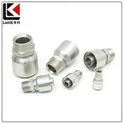
Hey there! As a supplier of METRIC Adapters, I often get asked about the weight of these little but crucial components. You might be thinking, "Why does the weight matter?" Well, it turns out that the weight of a METRIC Adapter can tell you a lot about its quality, material, and how it'll perform in different applications.

First off, let's talk about what a METRIC Adapter is. Simply put, it's a device that allows you to connect two different hydraulic or mechanical parts that have metric - sized fittings. These adapters are used in all sorts of industries, from automotive to aerospace, and they come in a wide variety of shapes and sizes.

Now, the weight of a METRIC Adapter can vary greatly depending on several factors. One of the most significant factors is the material it's made from. Common materials for these adapters include steel, brass, and aluminum. Steel adapters are generally the heaviest because steel is a dense material. It offers high strength and durability, making it suitable for high - pressure applications. Brass, on the other hand, is a bit lighter than steel. It's also corrosion - resistant, which is great for use in environments where the adapter might be exposed to moisture or chemicals. Aluminum is the lightest of the three. It's often used when weight is a critical factor, such as in aerospace applications, but it may not be as strong as steel.
Let's take a closer look at how the weight affects the performance. A heavier adapter, like one made of steel, can handle more stress. If you're working with a high - pressure hydraulic system, a steel METRIC Adapter can withstand the force without deforming or breaking. The weight also adds to its stability. In a vibration - prone environment, a heavier adapter is less likely to come loose.
On the flip side, a lighter adapter, such as an aluminum one, has its own advantages. In applications where every ounce matters, like in portable hydraulic equipment or aircraft, the reduced weight can lead to better fuel efficiency or easier handling.
Another factor that influences the weight is the size of the adapter. A larger adapter will naturally weigh more than a smaller one. The thread size, the length, and the overall dimensions all play a role. For example, a METRIC Adapter with a larger diameter thread will need more material to be manufactured, thus increasing its weight.
When it comes to choosing the right METRIC Adapter, the weight should be considered along with other factors. You need to think about the operating conditions, the pressure requirements, and the budget. If you're on a tight budget, a brass adapter might be a good compromise between cost and performance. If you need the highest strength, steel is the way to go, even though it's heavier and more expensive.
Now, let's talk about some of the specific types of adapters we offer. We have the JIC To BSP Adapter. This adapter is used to connect JIC (Joint Industry Council) fittings to BSP (British Standard Pipe) fittings. The weight of this adapter can vary depending on the size and material. A steel JIC To BSP Adapter will be heavier than an aluminum one, but it'll also be able to handle higher pressures.
We also offer Hydraulic Plugs and Caps. These are used to seal hydraulic ports when they're not in use. The weight of these plugs and caps is usually quite light, but it still matters. A heavier plug or cap might provide a better seal, especially in high - pressure systems.
Our Flange Joint is another important product. Flange joints are used to connect pipes or hoses in a hydraulic system. The weight of a flange joint depends on its size and the material. Larger flange joints will be heavier, and steel flange joints will be heavier than brass or aluminum ones.
If you're in the market for METRIC Adapters or any of our other hydraulic products, it's important to consider the weight as part of your decision - making process. Don't just focus on the price or the brand. Think about how the weight will impact the performance and the overall functionality of your system.
So, if you're wondering what the weight of a METRIC Adapter is, there's no one - size - fits - all answer. It depends on the material, the size, and the specific type of adapter. But by understanding these factors, you can make an informed decision when it comes to purchasing the right adapter for your needs.

If you have any questions or if you're interested in discussing your specific requirements, feel free to reach out. We're here to help you find the perfect METRIC Adapter and other hydraulic components for your project. Whether you're a small - scale workshop or a large - scale industrial operation, we've got the products and the expertise to meet your needs. Let's start a conversation and see how we can work together to get you the best - fitting solutions.
References
- Hydraulic Fitting Handbook
- Industrial Adapter Manufacturing Guidelines