Hey there! As a JIC Adaptor supplier, I've often been asked how JIC adaptors stack up against NPT adaptors. So, let's dive right into it and see what makes these two types of adaptors different and which one might be the better choice for your needs.
What Are JIC Adaptors and NPT Adaptors?
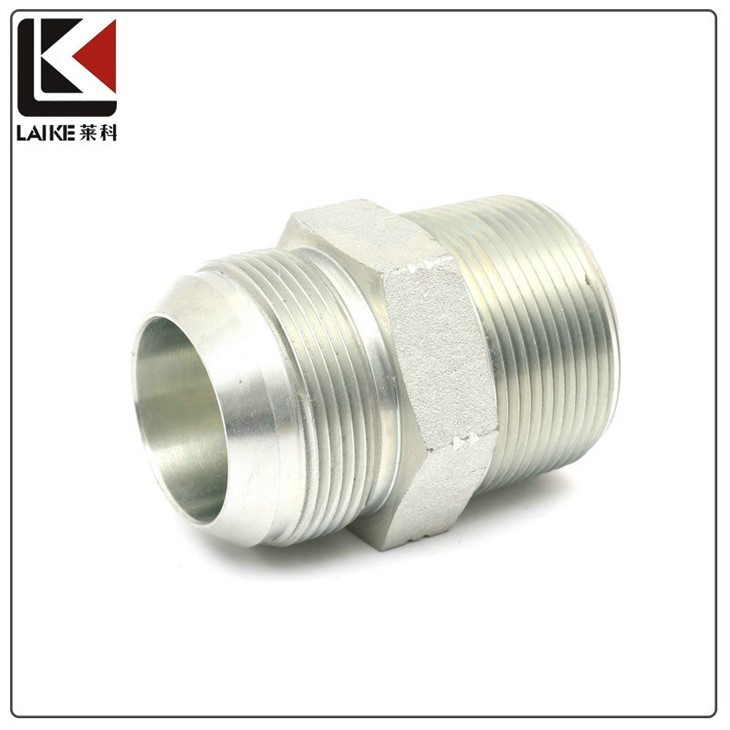
First off, let's get a basic understanding of what JIC and NPT adaptors are. JIC (Joint Industry Council) adaptors are a type of hydraulic fitting that uses a 37-degree flare to create a seal. They're widely used in hydraulic systems because they provide a reliable and leak-free connection. On the other hand, NPT (National Pipe Taper) adaptors are threaded fittings that rely on the taper of the threads to create a seal. They're commonly used in plumbing and some hydraulic applications.
Design and Construction
One of the key differences between JIC and NPT adaptors lies in their design. JIC adaptors have a 37-degree flare on the end, which is mated with a corresponding 37-degree seat. This design allows for a metal-to-metal seal, which is very effective in preventing leaks. The flare also provides a strong mechanical connection, which can withstand high pressures.
NPT adaptors, on the other hand, use tapered threads. The taper of the threads causes the male and female parts to wedge together as they're tightened, creating a seal. However, this type of seal can be prone to leaks if the threads aren't properly tightened or if there's debris in the threads.
Sealing Performance
When it comes to sealing performance, JIC adaptors have a clear advantage. The metal-to-metal seal provided by the 37-degree flare is highly effective in preventing leaks, even under high pressures. This makes JIC adaptors a great choice for hydraulic systems where leaks can be a major problem.
NPT adaptors, while they can provide a good seal, are more prone to leaks. The tapered threads can be difficult to tighten correctly, and even a small amount of debris in the threads can cause a leak. Additionally, NPT adaptors may require the use of thread sealant to ensure a proper seal, which can add to the cost and complexity of the installation.
Pressure Rating
Another important factor to consider is the pressure rating of the adaptors. JIC adaptors are designed to handle high pressures, typically up to 10,000 psi or more. This makes them suitable for a wide range of hydraulic applications, including high-pressure systems.
NPT adaptors, on the other hand, have a lower pressure rating. They're typically rated for pressures up to 3,000 psi, which may be sufficient for some applications but not for high-pressure systems.
Installation and Maintenance
Installing JIC adaptors is relatively straightforward. The flare fitting can be easily connected to the corresponding seat using a wrench. However, it's important to ensure that the flare is properly formed and that the fitting is tightened to the correct torque.
Installing NPT adaptors can be a bit more challenging. The tapered threads need to be carefully aligned and tightened to the correct torque to ensure a proper seal. Additionally, as mentioned earlier, thread sealant may be required to prevent leaks.
In terms of maintenance, JIC adaptors are generally easier to maintain. The metal-to-metal seal is less likely to degrade over time, and the fittings can be easily disassembled and reassembled if necessary. NPT adaptors, on the other hand, may require more frequent maintenance to ensure that the threads are clean and that the seal is still intact.
Compatibility
JIC adaptors are designed to be compatible with other JIC fittings and components. This makes it easy to build a hydraulic system using JIC adaptors and other JIC parts. However, it's important to note that JIC adaptors are not compatible with NPT fittings, so you'll need to use an adapter if you need to connect a JIC fitting to an NPT fitting.
NPT adaptors are widely used in plumbing and some hydraulic applications, and they're compatible with other NPT fittings. However, like JIC adaptors, they're not compatible with JIC fittings without an adapter.
Cost
The cost of JIC and NPT adaptors can vary depending on the size, material, and quantity. In general, JIC adaptors tend to be more expensive than NPT adaptors. This is because JIC adaptors are designed for high-pressure applications and require more precise manufacturing.
However, it's important to consider the long-term cost when choosing between JIC and NPT adaptors. While JIC adaptors may be more expensive upfront, they can provide a more reliable and leak-free connection, which can save you money in the long run by reducing the need for maintenance and repairs.

When to Choose JIC Adaptors
So, when should you choose JIC adaptors? Here are some situations where JIC adaptors are a good choice:
- High-pressure applications: If you're working with a hydraulic system that operates at high pressures, JIC adaptors are the way to go. Their metal-to-metal seal and high-pressure rating make them suitable for these types of applications.
- Leak-free connections: If you need a leak-free connection, JIC adaptors are a great choice. The 37-degree flare provides a reliable seal that can prevent leaks even under high pressures.
- Precision and reliability: If you need a precise and reliable connection, JIC adaptors are a good option. Their design and construction ensure a consistent and reliable performance.
When to Choose NPT Adaptors
On the other hand, there are some situations where NPT adaptors may be a better choice:
- Low-pressure applications: If you're working with a system that operates at low pressures, NPT adaptors may be sufficient. Their lower pressure rating is suitable for these types of applications.
- Plumbing applications: NPT adaptors are widely used in plumbing applications, so if you're working on a plumbing project, they may be the best choice.
- Cost-sensitive applications: If cost is a major factor, NPT adaptors may be a better option. They're generally less expensive than JIC adaptors, which can make them a good choice for cost-sensitive projects.
Conclusion
In conclusion, both JIC and NPT adaptors have their own advantages and disadvantages. JIC adaptors are a great choice for high-pressure applications, leak-free connections, and precision and reliability. NPT adaptors, on the other hand, are suitable for low-pressure applications, plumbing applications, and cost-sensitive projects.
As a JIC Adaptor supplier, I can offer you a wide range of high-quality JIC adaptors that are designed to meet your specific needs. If you're interested in learning more about our products or have any questions, please don't hesitate to contact us. We'd be happy to help you find the right adaptors for your application.
If you want to explore more about hydraulic fittings, you can check out FJX Hydraulic Fittings, Adapter Hydraulic, and JIC Adaptor.
References
- "Hydraulic Fittings Handbook" by Parker Hannifin Corporation
- "Fluid Power Technology" by Donald G. Fitch