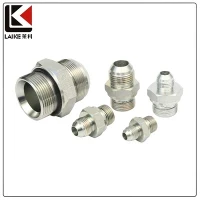
The fatigue life of a JIC to JIC adapter is a critical factor that determines its reliability and performance in various hydraulic systems. As a leading supplier of JIC to JIC adapters, we understand the importance of providing our customers with high - quality products that can withstand the rigors of continuous use. In this blog, we will explore what the fatigue life of a JIC to JIC adapter is, the factors that influence it, and how we ensure our adapters offer long - lasting performance.
Understanding Fatigue Life
Fatigue life refers to the number of stress cycles a component can endure before it fails due to fatigue. In the context of a JIC to JIC adapter, fatigue failure typically occurs when the adapter is subjected to repeated loading and unloading, such as pressure fluctuations in a hydraulic system. When the stress levels exceed the material's endurance limit over time, small cracks start to form. These cracks gradually grow with each cycle until the adapter can no longer function properly, leading to leaks or even complete failure.
Factors Influencing the Fatigue Life of JIC to JIC Adapters
Material Quality
The material used to manufacture the JIC to JIC adapter is one of the most significant factors affecting its fatigue life. High - quality materials, such as stainless steel or high - grade alloy steel, have better mechanical properties, including higher strength and toughness. These materials can resist crack initiation and propagation better than lower - quality alternatives. For example, stainless steel is corrosion - resistant, which is crucial in environments where the adapter may be exposed to moisture or chemicals. This corrosion resistance helps maintain the integrity of the material, reducing the risk of fatigue failure caused by corrosion - induced stress concentration.


Design and Geometry
The design and geometry of the JIC to JIC adapter also play a vital role in its fatigue life. Adapters with smooth transitions and proper fillet radii at critical points can distribute stress more evenly. Sharp corners or sudden changes in cross - section can create stress concentrations, which are areas where cracks are more likely to start. Our engineering team pays close attention to these details during the design process. We use advanced computer - aided design (CAD) software to optimize the adapter's shape, ensuring that stress is distributed as uniformly as possible across the component.
Operating Conditions
The operating conditions of the hydraulic system in which the JIC to JIC adapter is installed have a significant impact on its fatigue life. Factors such as pressure, temperature, and the frequency of pressure cycles all matter. High - pressure systems subject the adapter to greater stress, which can accelerate fatigue. Similarly, extreme temperatures can affect the material's properties. For instance, at high temperatures, the material may become softer, reducing its strength and increasing the risk of fatigue failure. Frequent pressure cycles also contribute to fatigue, as each cycle adds to the cumulative damage of the adapter.
Our Approach to Ensuring Long Fatigue Life
As a JIC to JIC adapter supplier, we take several steps to ensure that our products have a long fatigue life.
Rigorous Material Selection
We source our materials from trusted suppliers and conduct thorough quality checks. Before using any material in production, we test its mechanical properties, including tensile strength, yield strength, and hardness. This ensures that only materials that meet our strict quality standards are used in the manufacturing process. By using high - quality materials, we lay the foundation for adapters with excellent fatigue resistance.
Advanced Manufacturing Processes
We employ advanced manufacturing processes, such as precision machining and heat treatment. Precision machining allows us to achieve tight tolerances and smooth surface finishes, which are essential for reducing stress concentrations. Heat treatment, on the other hand, can improve the material's mechanical properties. For example, quenching and tempering can increase the strength and toughness of the adapter, enhancing its ability to withstand fatigue.
Comprehensive Testing
Before our JIC to JIC adapters are released to the market, they undergo comprehensive testing. We use specialized testing equipment to simulate real - world operating conditions. This includes subjecting the adapters to cyclic pressure tests, where they are exposed to a large number of pressure cycles to evaluate their fatigue life. We also conduct environmental tests to assess the adapter's performance under different temperature and humidity conditions. Only adapters that pass all our tests are considered suitable for sale.
Comparison with Other Adapter Types
When considering the fatigue life of JIC to JIC adapters, it's useful to compare them with other types of adapters, such as NPT Adapters and Jis Fittings. NPT adapters are commonly used in threaded connections. While they are suitable for many applications, their fatigue life may be affected by the nature of the threaded connection. Threads can create stress concentrations, and improper tightening can lead to uneven stress distribution, potentially reducing the fatigue life.
Jis fittings, on the other hand, have their own design characteristics. They are often used in Japanese - standard hydraulic systems. However, compared to JIC to JIC adapters, the fatigue life of Jis fittings may vary depending on the specific application and the quality of manufacturing. Our JIC to JIC adapters are designed to offer a balance of performance and reliability, with a focus on maximizing fatigue life through careful material selection and design.
Another type of adapter is the JIC To BSP Adapter. This adapter is used to connect JIC and BSP (British Standard Pipe) components. Similar to other adapters, its fatigue life is influenced by factors such as material, design, and operating conditions. Our JIC to JIC adapters, with their optimized design and high - quality materials, are engineered to provide a longer fatigue life compared to some of these alternative adapter types.
Importance of Long Fatigue Life in Hydraulic Systems
A JIC to JIC adapter with a long fatigue life is essential for the overall reliability of a hydraulic system. In industrial applications, hydraulic systems are often used in critical processes, such as manufacturing, construction, and transportation. A failure of a JIC to JIC adapter can lead to system downtime, which can be costly in terms of lost production and repair expenses. Additionally, leaks caused by adapter failure can result in environmental contamination and safety hazards. By using adapters with a long fatigue life, our customers can reduce the risk of these issues, ensuring the smooth and efficient operation of their hydraulic systems.
Conclusion
In conclusion, the fatigue life of a JIC to JIC adapter is determined by a combination of factors, including material quality, design, and operating conditions. As a supplier, we are committed to providing our customers with high - quality adapters that offer long - lasting performance. Through rigorous material selection, advanced manufacturing processes, and comprehensive testing, we ensure that our JIC to JIC adapters can withstand the challenges of continuous use in various hydraulic systems.
If you are in the market for JIC to JIC adapters and are looking for products with a long fatigue life, we invite you to contact us for more information. Our team of experts is ready to assist you in selecting the right adapter for your specific application. We can also provide detailed technical specifications and help you with any questions you may have about our products. Let's start a conversation to find the best solution for your hydraulic system needs.
References
- Shigley, J. E., Mischke, C. R., & Budynas, R. G. (2004). Mechanical Engineering Design. McGraw - Hill.
- Dowling, N. E. (2012). Mechanical Behavior of Materials: Engineering Methods for Deformation, Fracture, and Fatigue. Pearson.
- Hertzberg, R. W., Vinci, J. P., & Hertzberg, R. D. (2013). Deformation and Fracture Mechanics of Engineering Materials. Wiley.