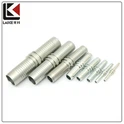
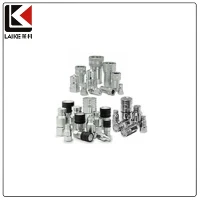
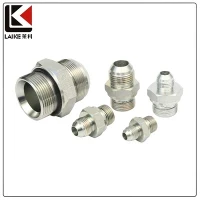
JIS (Japanese Industrial Standards) fittings are widely recognized and used in various industries for their high - quality and standardized design. As a JIS fittings supplier, understanding the flow capacity of these fittings is crucial for both us and our customers. In this blog, we'll delve into what the flow capacity of JIS fittings is, the factors influencing it, and why it matters in real - world applications.
What is Flow Capacity?
Flow capacity, in the context of JIS fittings, refers to the maximum volume of fluid (such as water, oil, or gas) that can pass through a fitting under specific conditions. It is typically measured in units like liters per minute (L/min), gallons per minute (GPM), or cubic meters per hour (m³/h). The flow capacity is not a fixed value; rather, it depends on multiple factors, including the size of the fitting, the type of fluid, the pressure differential across the fitting, and the internal design of the fitting itself.
Factors Affecting the Flow Capacity of JIS Fittings
1. Fitting Size
The size of a JIS fitting, often determined by its nominal diameter, plays a significant role in its flow capacity. Generally, larger - diameter fittings can accommodate a greater volume of fluid flow. For example, a JIS fitting with a 2 - inch nominal diameter will have a higher flow capacity than a 1 - inch fitting. This is because a larger cross - sectional area provides less resistance to the fluid flow. As the fluid moves through the fitting, a larger area allows it to spread out more easily, reducing the frictional forces that can impede flow.
2. Fluid Properties
The properties of the fluid being transported also impact the flow capacity. Viscosity is one of the most important fluid properties in this regard. Viscous fluids, such as heavy oils, have a higher internal resistance to flow compared to less viscous fluids like water. A more viscous fluid will experience greater frictional losses as it passes through the JIS fitting, resulting in a lower flow capacity. Temperature can also affect fluid viscosity; for most fluids, viscosity decreases as temperature increases, which can potentially increase the flow capacity through the fitting.
3. Pressure Differential
The pressure differential across a JIS fitting is the driving force behind fluid flow. A larger pressure difference between the inlet and the outlet of the fitting will result in a higher flow rate. According to Bernoulli's principle, an increase in pressure energy at the inlet can be converted into kinetic energy, causing the fluid to flow more rapidly through the fitting. However, it's important to note that there are limits to how much pressure can be applied. Excessive pressure can lead to damage to the fitting, such as leakage or even structural failure.
4. Fitting Design
The internal design of JIS fittings can significantly influence their flow capacity. Fittings with smooth internal surfaces and well - designed flow paths will have less resistance to fluid flow. For example, fittings with rounded corners and gradual transitions between different sections will reduce turbulence and frictional losses, allowing for a higher flow capacity. On the other hand, fittings with sharp edges, sudden contractions, or expansions can cause significant disruptions to the fluid flow, increasing resistance and reducing the overall flow capacity.
Calculating the Flow Capacity of JIS Fittings
There are several methods to calculate the flow capacity of JIS fittings. One common approach is to use the Darcy - Weisbach equation, which relates the head loss (pressure drop) in a pipe or fitting to the flow rate, pipe characteristics, and fluid properties. The equation is as follows:
[h_f = f\frac{L}{D}\frac{V^{2}}{2g}]
where (h_f) is the head loss, (f) is the Darcy friction factor, (L) is the length of the fitting, (D) is the diameter of the fitting, (V) is the average fluid velocity, and (g) is the acceleration due to gravity.


By rearranging this equation and solving for the flow rate (Q) (where (Q = A\times V) and (A) is the cross - sectional area of the fitting), we can estimate the flow capacity. However, calculating the Darcy friction factor (f) can be complex, as it depends on factors such as the Reynolds number (a dimensionless quantity that describes the flow regime) and the roughness of the internal surface of the fitting.
In practice, many manufacturers provide flow capacity charts for their JIS fittings. These charts are based on experimental data and take into account the specific design and dimensions of the fittings. By referring to these charts, users can quickly determine the approximate flow capacity for a given fitting under different operating conditions.
Importance of Understanding Flow Capacity in Applications
1. System Design
In hydraulic and pneumatic systems, accurate knowledge of the flow capacity of JIS fittings is essential for proper system design. If the flow capacity of the fittings is underestimated, the system may not be able to deliver the required volume of fluid, leading to reduced performance or even system failure. On the other hand, overestimating the flow capacity can result in the use of oversized fittings, which can increase costs and take up unnecessary space.
2. Efficiency and Performance
Optimizing the flow capacity of JIS fittings can improve the overall efficiency of a system. By minimizing frictional losses and ensuring smooth fluid flow, less energy is required to pump the fluid through the system. This not only reduces operating costs but also extends the lifespan of the system components. For example, in an industrial hydraulic system, using JIS fittings with the appropriate flow capacity can improve the response time of hydraulic actuators and increase the productivity of the machinery.
Our Offerings as a JIS Fittings Supplier
As a leading JIS fittings supplier, we offer a wide range of products to meet different flow capacity requirements. Our Hydraulic Flange Adapters are designed with precision to ensure smooth fluid flow and high flow capacity. These adapters are suitable for high - pressure hydraulic systems and are available in various sizes to accommodate different flow rates.
Our Pipe Fittings are another important part of our product line. They are made from high - quality materials and feature a well - engineered design to minimize flow resistance. Whether you need straight connectors, elbows, or tees, we have the right pipe fittings to meet your needs.
We also offer Kumatsu Adapter, which are known for their reliability and compatibility with a variety of equipment. These adapters are carefully crafted to provide a seamless connection and maintain optimal flow capacity.
Contact Us for Procurement
If you are in need of JIS fittings with specific flow capacity requirements, we encourage you to reach out to us. Our team of experts can assist you in selecting the right fittings for your application, taking into account factors such as fluid properties, pressure differentials, and system design. We are committed to providing high - quality products and excellent customer service. Whether you are a small - scale workshop or a large industrial enterprise, we have the solutions to meet your needs. Contact us today to start your procurement process and ensure the smooth operation of your fluid systems.
References
- Crane Co., "Flow of Fluids Through Valves, Fittings, and Pipe," Technical Paper No. 410.
- Munson, B. R., Young, D. F., & Okiishi, T. H., "Fundamentals of Fluid Mechanics," Wiley.
- Streeter, V. L., & Wylie, E. B., "Fluid Mechanics," McGraw - Hill.