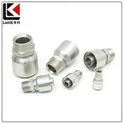
As a trusted hose fitting supplier, I often encounter questions from customers about the suitability of ball valve hose fittings for different fluids. In this blog post, I'll delve into the details of whether ball valve hose fittings are appropriate for all types of fluids, exploring their advantages, limitations, and key considerations.
Understanding Ball Valve Hose Fittings
Ball valve hose fittings are a popular choice in many fluid - handling applications. They consist of a spherical disc (the ball) with a hole through it. When the ball is rotated, the hole aligns with the flow path to allow fluid to pass through, or it can be turned perpendicular to the flow path to shut off the flow. These fittings are known for their quick and reliable on - off operation, as well as their relatively low pressure drop when fully open.
Advantages of Ball Valve Hose Fittings
One of the main advantages of ball valve hose fittings is their versatility. They can handle a wide range of fluid types, including water, oil, and some chemicals. For water applications, such as in plumbing systems or irrigation, ball valve hose fittings provide a simple and effective way to control the flow. Their smooth internal surface reduces the likelihood of sediment buildup, ensuring long - term performance.
In the oil industry, ball valve hose fittings are used extensively. They can withstand high pressures and are resistant to the corrosive effects of oil and other petroleum - based products. The quick - acting nature of ball valves is also beneficial in emergency shut - off situations, where rapid isolation of the fluid flow is required.
When it comes to chemicals, certain ball valve hose fittings made from materials like stainless steel or PVC can be used. For example, in chemical processing plants, stainless - steel ball valves can handle mild acids and alkalis, offering reliable performance and corrosion resistance.
Limitations and Considerations
However, it's important to note that ball valve hose fittings are not suitable for all fluids. Some fluids have properties that can cause problems with ball valves.
Viscous Fluids
Highly viscous fluids, such as thick oils or slurries, can pose challenges. The movement of the ball within the valve can be restricted by the high viscosity, making it difficult to operate the valve smoothly. In addition, viscous fluids may leave residues on the ball and valve seats, leading to leakage over time. For such applications, alternative valve types like gate valves or diaphragm valves may be more appropriate.
Abrasive Fluids
Fluids containing abrasive particles, such as sand or grit, can cause significant wear on the ball and valve seats of ball valve hose fittings. The abrasion can lead to reduced sealing performance and eventually valve failure. In these cases, valves with hardened surfaces or special linings are required. For instance, ceramic - lined ball valves can provide better resistance to abrasion, but they come at a higher cost.
Reactive Fluids
Some reactive fluids can react with the materials of the ball valve. For example, certain strong acids or alkalis can corrode materials like carbon steel. In these situations, it's crucial to select ball valve hose fittings made from materials that are chemically compatible with the fluid. For extremely reactive fluids, exotic materials like Hastelloy or titanium may be necessary, but they are also more expensive.


Compatibility with Different Fluid Categories
Let's take a closer look at some common fluid categories and their compatibility with ball valve hose fittings.
Water - Based Fluids
For most water - based fluids, including tap water, treated water, and some wastewater, ball valve hose fittings are a great choice. They are cost - effective, easy to install, and offer reliable performance. Whether it's for residential plumbing or industrial water treatment systems, ball valves can handle the job well.
Oil and Lubricants
As mentioned earlier, ball valve hose fittings are widely used in the oil and lubricant industry. They can handle different grades of oil, from light - weight lubricating oils to heavy - duty hydraulic oils. However, for high - temperature or high - pressure oil applications, special considerations need to be taken. For example, the valve materials should be able to withstand the thermal expansion and high - pressure conditions.
Chemicals
The compatibility of ball valve hose fittings with chemicals depends on the specific chemical properties. Mild chemicals like acetic acid or sodium hydroxide can be handled by stainless - steel ball valves. But for more aggressive chemicals, such as hydrofluoric acid, specialized materials are required. It's always advisable to consult chemical compatibility charts or seek advice from a chemical engineer when dealing with reactive chemicals.
Our Product Range and Solutions
As a hose fitting supplier, we offer a wide range of ball valve hose fittings to meet different fluid - handling needs. In addition to standard ball valves, we also provide ORING Hydraulic Fittings, which are designed to provide a reliable seal in hydraulic systems. Our DIN Hydraulic Fittings comply with international standards, ensuring compatibility and high - quality performance. And for applications where flexibility is required, our Swivel Hydraulic Fitting can provide smooth rotation and easy installation.
We understand that choosing the right hose fittings for your fluid - handling application is crucial. Our team of experts can help you select the most suitable ball valve hose fittings based on your specific fluid type, pressure requirements, and operating conditions. We can also provide technical support and advice on installation, maintenance, and troubleshooting.
Conclusion
In conclusion, while ball valve hose fittings are versatile and can handle a wide range of fluids, they are not suitable for all situations. The properties of the fluid, such as viscosity, abrasiveness, and reactivity, need to be carefully considered when selecting ball valve hose fittings. By understanding the advantages and limitations of ball valves and choosing the right materials and designs, you can ensure reliable and efficient fluid - handling in your application.
If you are in the process of selecting hose fittings for your fluid - handling system, we encourage you to reach out to us. Our experienced team is ready to assist you in making the best choice for your needs. Whether it's a simple water - based application or a complex chemical - processing project, we have the products and expertise to support you. Contact us today to start a conversation about your fluid - handling requirements.
References
- "Valve Handbook" by Nathaniel B. Leopold.
- "Fluid Mechanics and Hydraulics" by Don W. F. Roach.
- Chemical Compatibility Databases from various manufacturers.