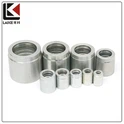
As a leading supplier of SAE Flange Adapters, I often encounter customers who are eager to understand how to calculate the flow rate through these essential components. In this blog post, I'll guide you through the process, providing you with the knowledge you need to make informed decisions about your hydraulic systems.
Understanding the Basics of Flow Rate
Before we dive into the calculations, let's first clarify what flow rate is. Flow rate refers to the volume of fluid that passes through a given point in a system per unit of time. It is typically measured in gallons per minute (GPM) or liters per minute (LPM). Understanding the flow rate is crucial for ensuring that your hydraulic system operates efficiently and effectively.
Factors Affecting Flow Rate Through an SAE Flange Adapter
Several factors can influence the flow rate through an SAE Flange Adapter. These include:
- Adapter Size: The size of the adapter, specifically the inner diameter, plays a significant role in determining the flow rate. Larger inner diameters generally allow for higher flow rates.
- Fluid Viscosity: Viscosity is a measure of a fluid's resistance to flow. Higher viscosity fluids, such as oils, will flow more slowly through the adapter compared to lower viscosity fluids.
- Pressure Drop: Pressure drop occurs when there is a decrease in pressure as the fluid flows through the adapter. A higher pressure drop can reduce the flow rate.
- System Design: The overall design of the hydraulic system, including the length and diameter of the pipes, the number of bends, and the presence of other components, can also affect the flow rate.
Calculating the Flow Rate
To calculate the flow rate through an SAE Flange Adapter, you can use the following steps:
Step 1: Determine the Cross - Sectional Area of the Adapter
The cross - sectional area (A) of the adapter can be calculated using the formula for the area of a circle:
[A=\pi\times(\frac{d}{2})^2]
where (d) is the inner diameter of the adapter. For example, if the inner diameter of the adapter is 2 inches, the cross - sectional area would be:
[A = \pi\times(\frac{2}{2})^2=\pi\times1^2=\pi\approx 3.14\space in^2]


Step 2: Measure the Velocity of the Fluid
The velocity (v) of the fluid can be measured using a flow meter or estimated based on the system design. If you know the volumetric flow rate (Q) and the cross - sectional area (A), you can calculate the velocity using the formula:
[v=\frac{Q}{A}]
For example, if the volumetric flow rate is 10 GPM and the cross - sectional area is 3.14 (in^2), first convert the flow rate to cubic inches per minute. Since 1 gallon is approximately 231 cubic inches, 10 GPM is (10\times231 = 2310\space in^3/min). Then the velocity is:
[v=\frac{2310}{3.14}\approx735.67\space in/min]
Step 3: Calculate the Flow Rate
Once you have the cross - sectional area and the velocity of the fluid, you can calculate the flow rate using the formula:
[Q = A\times v]
If you are working with SI units, make sure all the values are in consistent units. For example, if the cross - sectional area is in square meters and the velocity is in meters per second, the flow rate will be in cubic meters per second.
Using Empirical Formulas
In addition to the basic calculations, there are also empirical formulas that can be used to estimate the flow rate through an SAE Flange Adapter. One such formula is the Darcy - Weisbach equation, which takes into account the friction factor, the length of the pipe, the diameter of the pipe, and the velocity of the fluid. However, this equation is more complex and may require additional information about the system.
Importance of Accurate Flow Rate Calculation
Accurately calculating the flow rate through an SAE Flange Adapter is essential for several reasons:
- System Efficiency: Ensuring the correct flow rate helps to optimize the efficiency of the hydraulic system, reducing energy consumption and wear on the components.
- Component Selection: Knowing the flow rate allows you to select the appropriate size and type of SAE Flange Adapter for your system, preventing issues such as over - or under - sizing.
- Safety: Proper flow rate calculation helps to maintain the safety of the system by preventing excessive pressures or flow velocities that could lead to component failure or accidents.
Other Related Adapters
In addition to SAE Flange Adapters, we also offer a wide range of other hydraulic adapters, such as NPTF Adapter and American Adapter. These adapters are designed to meet the diverse needs of our customers and can be used in various hydraulic applications.
Contact Us for Your Adapter Needs
If you are looking for high - quality SAE Flange Adapters or any other hydraulic adapters, look no further. As a trusted supplier, we are committed to providing you with the best products and services. Whether you need help with flow rate calculations, adapter selection, or have any other questions, our team of experts is here to assist you. Contact us today to start a discussion about your specific requirements and take the first step towards optimizing your hydraulic system.
References
- "Fluid Mechanics" by Frank M. White
- "Hydraulic Systems Design and Application" by George E. Dieter