What is the contact resistance of a Fast Connector?
Hey there! I'm a supplier of Fast Connectors, and today I want to chat about the contact resistance of these nifty little devices. First off, let's get a clear idea of what a Fast Connector is. A Fast Connector is a type of coupling that allows for quick and easy connection and disconnection of various components in different systems. They're used in a whole bunch of industries, from manufacturing to automotive, and even in some home appliances.
Now, contact resistance. It's a pretty important concept when it comes to Fast Connectors. Contact resistance refers to the resistance that occurs at the interface between two conductors when they're in contact with each other. In the case of a Fast Connector, it's the resistance between the male and female parts of the connector when they're joined together.
Why does contact resistance matter? Well, it can have a big impact on the performance of the system that the Fast Connector is a part of. High contact resistance can lead to a few issues. For starters, it can cause a voltage drop across the connector. This means that the voltage that reaches the other end of the connection is lower than what's being supplied. In electrical systems, this can affect the operation of devices, making them work less efficiently or even malfunction.
Another problem with high contact resistance is that it generates heat. When current flows through a resistor (in this case, the contact resistance), power is dissipated in the form of heat according to the formula P = I²R (where P is power, I is current, and R is resistance). If the contact resistance is too high, a significant amount of heat can be generated. This not only wastes energy but can also damage the connector and the surrounding components over time.
There are several factors that can affect the contact resistance of a Fast Connector. One of the main factors is the material of the connector. Different metals have different electrical conductivities. For example, copper is a very good conductor and has relatively low resistance. So, connectors made of copper or copper alloys tend to have lower contact resistance compared to those made of other materials.
The surface finish of the connector also plays a crucial role. A smooth and clean surface provides better contact between the two parts of the connector, reducing the contact resistance. On the other hand, a rough or dirty surface can increase the resistance. Oxidation can also be a problem. When metals are exposed to air, they can form an oxide layer on their surface. This oxide layer is often a poor conductor and can significantly increase the contact resistance.
The force applied when connecting the two parts of the Fast Connector is another important factor. A higher contact force generally leads to lower contact resistance. When the parts are pressed together more firmly, there's a larger area of contact between them, which reduces the resistance. However, there's a limit to how much force can be applied, as too much force can damage the connector.
As a Fast Connector supplier, we take these factors into account when manufacturing our products. We use high - quality materials with good electrical conductivity. We also pay close attention to the surface finish of the connectors. We make sure that the surfaces are smooth and free from dirt and oxidation during the manufacturing process. And we design our connectors in such a way that they can be connected with an appropriate amount of force to ensure low contact resistance.
In addition to electrical Fast Connectors, there are also Hydraulic Quick Connect Couplings and Hydraulic Quick Couplers. In the case of hydraulic connectors, the concept of contact resistance is a bit different. Instead of electrical resistance, we're talking about fluid resistance. When the two parts of a hydraulic coupling are connected, there can be some resistance to the flow of hydraulic fluid through the connection.
Just like in electrical connectors, factors such as the design of the coupling, the quality of the seals, and the cleanliness of the components can affect the fluid resistance. A well - designed hydraulic coupling will have minimal fluid resistance, allowing for efficient flow of hydraulic fluid. This is important for the proper operation of hydraulic systems, as any increase in fluid resistance can lead to a decrease in system performance, such as slower actuator movement or higher energy consumption.
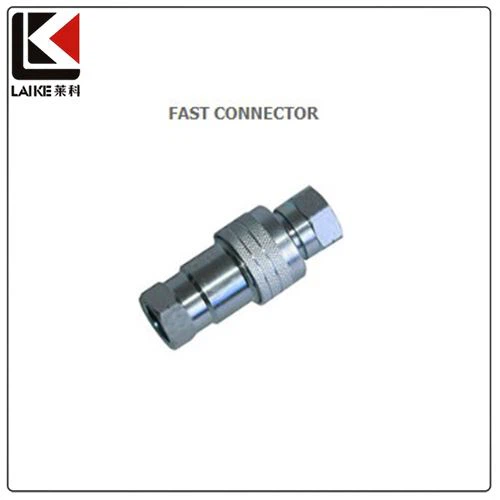
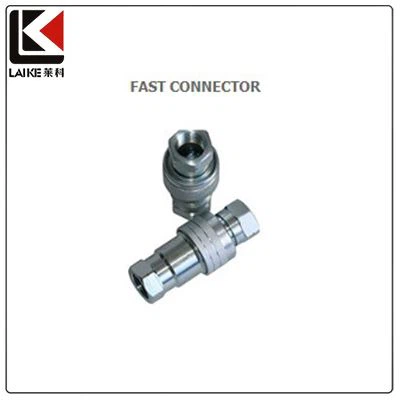
So, if you're in the market for Fast Connectors, whether they're electrical or hydraulic, it's important to consider the contact resistance (or fluid resistance in the case of hydraulic connectors). You want to make sure that the connectors you choose will provide a reliable and efficient connection.
If you're interested in learning more about our Fast Connectors or have any questions about contact resistance, feel free to reach out. We're always happy to have a chat and discuss how our products can meet your needs. Whether you're a small business looking for a few connectors or a large corporation with high - volume requirements, we've got you covered. Let's start a conversation and see how we can work together to solve your connection problems.
References
- Electrical Engineering textbooks on circuit theory and connector design
- Industry standards and guidelines for Fast Connectors and hydraulic couplings