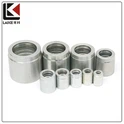
Hey there! As a hose fitting supplier, I often get asked, "Are there different sizes of hose fittings?" The short answer is yes, and in this blog, I'll dive deep into why these variations matter and how they impact your projects.
First off, let's understand why different sizes of hose fittings exist. In the real - world applications, hoses are used in a wide range of industries, from automotive to construction, and from agriculture to manufacturing. Each industry has its own unique requirements when it comes to fluid transfer, pressure, and flow rate. That's where the different sizes of hose fittings come into play.
For instance, in a high - pressure hydraulic system, you'll need a fitting that can withstand the force of the fluid flowing through it. These high - pressure systems usually require larger and more robust fittings. On the other hand, in a low - pressure application like a garden hose, a smaller and more lightweight fitting will do the job just fine.
Let's talk about the common sizes you might encounter. There are standard sizes that are widely used across the industry. For example, in the hydraulic world, sizes like 1/4", 3/8", 1/2", and 3/4" are pretty common. These sizes are measured based on the inner diameter of the hose that the fitting is designed to connect to.
The 1/4" fitting is often used in small - scale hydraulic systems, such as those found in some types of machinery or in laboratory equipment. It's suitable for applications where the flow rate is relatively low, and the pressure is not extremely high.
Moving up to the 3/8" fitting, it can handle a bit more flow and pressure. You'll often see these in medium - sized hydraulic systems, like those in some industrial tools or small construction equipment.
The 1/2" and 3/4" fittings are for larger systems. They can handle higher flow rates and pressures, making them ideal for heavy - duty applications such as large construction machinery or industrial manufacturing plants.
But it's not just about the inner diameter. The outer diameter of the fitting also matters. A proper outer diameter ensures a secure and leak - free connection between the fitting and the hose. Some fittings are designed with a specific outer diameter to match the corresponding hose and other components in the system.
Now, let's take a look at some of the different types of hose fittings and how size plays a role. One type is the Hydraulic Hose Tails. These are used to connect hoses to various components in a hydraulic system. The size of the hydraulic hose tails is crucial because it needs to match the size of the hose and the component it's connecting to. If the size is off, you could end up with a leaky connection, which can lead to a loss of fluid, reduced system performance, and even safety hazards.
Another important type is the Hydraulic Hose Accessories. These include things like adapters, couplings, and valves. Accessories come in different sizes to fit different hoses and systems. For example, an adapter might be used to connect a hose of one size to a component of a different size. It's essential to choose the right size accessory to ensure a proper fit and smooth operation of the system.
Then there's the Hydraulic Ferrule. Ferrules are used to secure the hose to the fitting. They come in various sizes to match different hose diameters. A well - sized ferrule will grip the hose tightly, preventing it from slipping out under pressure. If the ferrule is too small, it won't fit properly on the hose, and if it's too large, it won't provide a secure connection.
When you're choosing the right size of hose fitting, there are a few things you need to consider. First, you need to know the requirements of your system. What's the pressure rating? What's the flow rate? These factors will help you determine the appropriate size of the fitting.
You also need to measure the hose accurately. Make sure you measure the inner and outer diameters correctly. Sometimes, hoses can stretch or shrink over time, so it's a good idea to measure them at multiple points to get an accurate reading.
It's also important to consider the compatibility of the fitting with other components in the system. You want to make sure that all the parts work together seamlessly. For example, if you're using a certain type of valve, the fitting you choose should be able to connect to it properly.
As a hose fitting supplier, I've seen firsthand how choosing the wrong size can cause a lot of problems. I've had customers come to me with leaky systems or components that just don't work right because they used the wrong size fitting. That's why I always recommend taking the time to do your research and make sure you're getting the right size for your needs.
If you're still not sure which size of hose fitting is right for your project, don't worry. We're here to help! Our team of experts has years of experience in the industry, and we can guide you through the process of choosing the perfect fitting. Whether you're working on a small DIY project or a large - scale industrial installation, we've got the knowledge and the products to meet your needs.


In conclusion, there are definitely different sizes of hose fittings, and choosing the right one is crucial for the proper functioning of your system. From small - scale applications to heavy - duty industrial use, the size of the fitting plays a vital role in ensuring a secure, leak - free, and efficient connection.
If you're in the market for hose fittings and need some advice or want to place an order, feel free to reach out. We're ready to assist you with all your hose fitting needs. Let's work together to get your project up and running smoothly!
References:
- Industry standards for hose fittings
- Experience from working as a hose fitting supplier