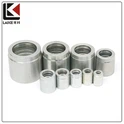
Hey there! I'm a supplier of hose fittings, and today I'm going to break down how a check valve hose fitting works. You might be wondering why it's important to know this. Well, whether you're in the manufacturing industry, automotive, or any field that uses fluid systems, understanding check valve hose fittings can save you a lot of headaches and money in the long run.
Let's start with the basics. A check valve hose fitting is a crucial component in a fluid system. Its main job is to control the flow of fluid in a single direction. Think of it like a one - way street for fluids. It allows the fluid to move forward when the pressure on the inlet side is higher than the outlet side, but it prevents the fluid from flowing back when the pressure conditions reverse.
The Anatomy of a Check Valve Hose Fitting
To understand how it works, we first need to know what it's made of. A typical check valve hose fitting consists of a valve body, a valve seat, a disc or ball (depending on the type), and sometimes a spring. The valve body is the outer casing that holds all the other parts together. It's usually made of materials like brass, stainless steel, or plastic, depending on the application and the type of fluid it will handle. For example, if you're dealing with corrosive fluids, stainless steel would be a great choice.
The valve seat is where the disc or ball sits when the valve is closed. It's designed to create a tight seal to prevent any backflow. The disc or ball is the moving part that opens and closes the valve. When the fluid pressure on the inlet side is sufficient, it pushes the disc or ball away from the valve seat, allowing the fluid to flow through. When the pressure on the outlet side becomes higher or the flow stops, the disc or ball is forced back onto the valve seat, closing the valve.
Some check valve hose fittings also have a spring. The spring helps to control the opening and closing pressure of the valve. It adds an extra level of precision to the valve's operation. For instance, in a system where you need a specific pressure to open the valve, the spring can be adjusted or selected to meet that requirement.
How It Works in Action
Let's walk through a real - world scenario. Imagine you have a hydraulic system in a construction machine. The system uses a pump to push hydraulic fluid through the hoses to power different components like the boom or the bucket. At the end of each hose, there's a check valve hose fitting.
When the pump starts working, it creates pressure in the hose. The pressure on the inlet side of the check valve becomes higher than the pressure on the outlet side. This pressure difference forces the disc or ball in the check valve to move away from the valve seat. As a result, the hydraulic fluid can flow freely through the valve and into the component it's supposed to power.
Now, let's say the pump stops. Without the check valve, the hydraulic fluid in the component would flow back into the hose due to gravity or the pressure in the component itself. But the check valve prevents this from happening. As the pressure on the inlet side drops, the disc or ball is pushed back onto the valve seat by the pressure on the outlet side and, in some cases, the force of the spring. This creates a tight seal, and the fluid is trapped in the component, maintaining its position.
Types of Check Valve Hose Fittings
There are several types of check valve hose fittings, each with its own unique working mechanism and application.


Swing Check Valve
A swing check valve has a disc that swings on a hinge. When the fluid flows in the correct direction, the disc swings open. When the flow reverses, the disc swings back onto the valve seat to close the valve. Swing check valves are great for applications where the flow rate is relatively high and the fluid has a low viscosity. They're commonly used in water supply systems and some industrial piping systems.
Ball Check Valve
In a ball check valve, a ball is used instead of a disc. The ball is pushed away from the valve seat by the fluid pressure to allow flow. When the pressure reverses, the ball is forced back onto the seat. Ball check valves are known for their quick response time and are often used in applications where a fast - closing valve is required, such as in fuel systems or some chemical processing plants.
Spring - Loaded Check Valve
As mentioned earlier, spring - loaded check valves have a spring that helps control the opening and closing pressure. These valves are very precise and can be adjusted to open at a specific pressure. They're commonly used in applications where a consistent pressure is required, like in some medical equipment or high - precision hydraulic systems.
Why You Should Choose Our Hose Fittings
As a hose fitting supplier, we offer a wide range of check valve hose fittings to meet your specific needs. Our products are made from high - quality materials, ensuring durability and reliability. Whether you need a JIC Hydraulic Fittings for your hydraulic system or JIC Hose Fittings for a different application, we've got you covered. We also have FJX Fitting options that are designed to provide a secure and leak - free connection.
Our team of experts can help you choose the right check valve hose fitting for your project. We understand that every application is unique, and we're committed to providing you with the best solutions. We offer competitive prices and fast delivery, so you can get your project up and running in no time.
Contact Us for Procurement
If you're in the market for check valve hose fittings or any other hose fittings, don't hesitate to reach out to us. We're here to answer all your questions and help you make the right choice. Whether you're a small business or a large corporation, we can work with you to meet your procurement needs. Just drop us a message, and we'll start the conversation.
References
- "Fluid Mechanics and Hydraulic Machines" by R.K. Bansal
- "Handbook of Valves" by Robert E. Bailey
- Industry standards and guidelines for hose fittings and check valves