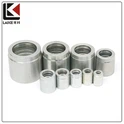
In the world of fluid handling and hydraulic systems, choosing the right adapter is crucial for ensuring a leak - free and efficient operation. As a supplier of NPTF (National Pipe Taper Fuel) adapters, I often encounter customers who are confused about the differences between NPTF and other types of adapters. In this blog post, I will explain in detail what sets NPTF apart from other common adapter types.


NPTF Adapters: An Overview
NPTF adapters are designed to provide a dry - seal connection in piping systems. They are part of the National Pipe Taper (NPT) family, but with a key difference. The NPTF threads are manufactured to tighter tolerances compared to standard NPT threads. This precision is what allows NPTF adapters to form a reliable seal without the need for additional sealing compounds in many applications.
The NPTF threads are tapered, which means the diameter of the thread decreases as it moves along the length of the pipe or fitting. When two NPTF - threaded components are tightened together, the tapered threads wedge against each other, creating a mechanical seal. This is especially important in applications where fluids or gases are under pressure, such as in fuel systems, hydraulic systems, and pneumatic systems.
Comparison with Standard NPT Adapters
Let's start by comparing NPTF with standard NPT Adapters. Standard NPT threads, while also tapered, do not always form a leak - proof seal on their own. Due to the looser tolerances in manufacturing, there can be small gaps between the mating threads, which may lead to leaks. To compensate for this, a sealing compound like Teflon tape or pipe dope is typically required when using standard NPT adapters.
On the other hand, NPTF adapters are designed to eliminate the need for such sealing compounds in most cases. The tighter tolerances ensure that the threads fit together more precisely, creating a better seal. This not only simplifies the installation process but also reduces the risk of contamination from the sealing compound, which can be a concern in some sensitive applications like food and beverage processing or pharmaceutical manufacturing.
Comparison with JIC Adapters
JIC To JIC Adapter is another common type of adapter used in hydraulic systems. JIC (Joint Industry Council) adapters are based on a 37 - degree flare fitting design. Unlike NPTF adapters, which rely on tapered threads for sealing, JIC adapters use a metal - to - metal seal at the flare surface.
The 37 - degree flare provides a large contact area between the mating components, which can withstand high pressures. JIC adapters are often used in high - pressure hydraulic applications, such as in construction equipment and industrial machinery. However, they require a specific flaring tool to create the proper flare on the tubing, which adds an extra step to the installation process.
In contrast, NPTF adapters can be used with standard pipe and do not require any special flaring. This makes them more versatile in some situations, especially when dealing with existing piping systems. Additionally, NPTF adapters can be used in a wider range of applications, including those where the fluid is not strictly hydraulic, such as in gas lines.
Comparison with METRIC Adapters
METRIC Adapter is used in systems that follow the metric measurement system. Metric adapters come in various thread sizes and profiles, and they are commonly used in European and Asian equipment. The main difference between NPTF and metric adapters lies in the thread dimensions and the sealing mechanism.
Metric threads are typically parallel, unlike the tapered threads of NPTF. This means that the sealing mechanism for metric adapters is different. Some metric adapters use O - rings or other elastomeric seals to prevent leaks, while others rely on a combination of thread engagement and a sealing surface.
The choice between NPTF and metric adapters often depends on the origin of the equipment and the existing piping system. If the equipment is from a country that uses the metric system, metric adapters may be the more appropriate choice. However, if the system is part of a mixed - origin setup or if NPTF is already established in the system, NPTF adapters may be preferred for compatibility and ease of replacement.
Applications of NPTF Adapters
NPTF adapters are widely used in a variety of industries. In the automotive industry, they are used in fuel lines, brake systems, and air conditioning systems. The dry - seal feature of NPTF adapters is particularly important in these applications to prevent fuel or refrigerant leaks, which can be a safety hazard.
In the oil and gas industry, NPTF adapters are used in pipelines, wellheads, and other equipment. The ability to form a reliable seal under high pressure and in harsh environments makes them suitable for these demanding applications.
In the manufacturing industry, NPTF adapters are used in hydraulic and pneumatic systems to connect various components such as pumps, valves, and cylinders. Their versatility and ease of installation make them a popular choice for both new installations and system upgrades.
Advantages of Choosing NPTF Adapters from Our Company
As a supplier of NPTF adapters, we take pride in offering high - quality products. Our NPTF adapters are manufactured using the latest technology and strict quality control measures. We ensure that each adapter meets or exceeds the industry standards for thread precision and sealing performance.
We also offer a wide range of sizes and configurations to meet the diverse needs of our customers. Whether you need a small - diameter adapter for a delicate instrument or a large - diameter adapter for an industrial pipeline, we have the right product for you.
In addition, our team of experts is always available to provide technical support and advice. We can help you select the most suitable adapter for your specific application, and we can also assist with installation and troubleshooting.
Conclusion
In conclusion, NPTF adapters have several unique features that set them apart from other types of adapters. Their ability to form a dry - seal connection, combined with their versatility and ease of installation, makes them a popular choice in many industries. While other adapter types like standard NPT, JIC, and metric adapters have their own advantages and are suitable for specific applications, NPTF adapters offer a reliable and cost - effective solution in a wide range of situations.
If you are in the market for NPTF adapters or need more information about the differences between NPTF and other types of adapters, please feel free to contact us. We are ready to assist you in making the right choice for your fluid handling and hydraulic system needs.
References
- ASME B1.20.3 - 2006, "National Pipe Threads (NPT)"
- SAE J514, "Flared Fittings"
- ISO 228 - 1, "Pipe threads where pressure - tight joints are not made on the threads — Part 1: Dimensions, tolerances and designation"